
by Gabriela Geselowitz
by Gabriela Geselowitz
To a working artist, tax season can be a nightmare, a labyrinth of documents from a year of many jobs on a variety of forms in multiple industries, even in different states or countries. But over the past five decades, thousands of Equity and SAG-AFTRA members have slept better knowing that their tax returns and audits are watertight. 2026 marks the 50th anniversary of the union's Volunteer Income Tax Assistance (VITA) program, saving headaches – and very often money – for actors and stage managers.
In 1976, VITA was only a few years old, launched in the wake of the 1969 Tax Reform Act, with the first public program opening its doors in 1971 at California State University, Northridge. The purpose of VITA was to support lower-income taxpayers and foster community service, and Equity Eastern Principal Councilor Michael Enserro saw it as a natural fit for Equity. Not only would many members qualify to receive the service, but they would especially benefit from their peers who had a knowledge of the industry and could understand their unique financial challenges as working artists. So, he connected with the IRS about bringing the program to the union. That first year, over 80 Equity members, led by Enserro and his fellow Eastern principal councilors Conard Fowkes and Schorling Schneider, took the first step of signing up for a three-day course teaching them the finer points of filing tax returns.
In the beginning, VITA volunteers were all councilors – and all men. Its second year, VITA's longest-serving (and first female) volunteer, Mary Lou Westerfield, joined the team. Westerfield was a new councilor, but she would go on to not only become the union's 2nd vice president but eventually work there as executive staff as well.
At first, VITA felt like a well-kept secret.
"Those of us who were volunteering in that second year would go out on tour and get that job and tell people, 'You know, you can come to Equity and have your taxes done,'" recalled Westerfield. "It was a lot of word of mouth, initially."
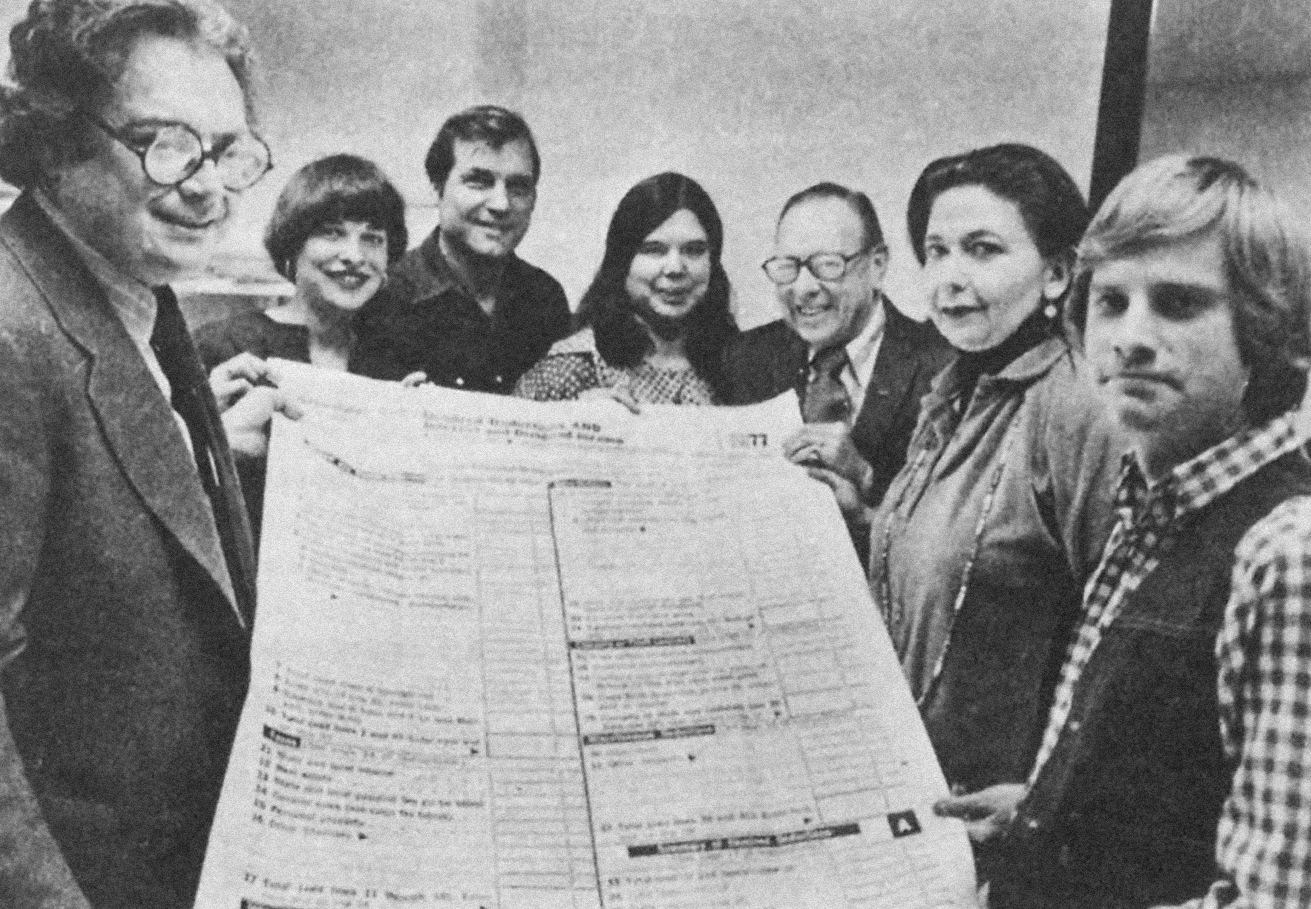
From 1979: Gathered around a giant 1040 Form at Equity's VITA program office are: (left to right) Henry Stockhold, Analyst, Taxpayers Service, IRS Regional Office; Darrell Weinberg, VITA Program Coordinator. Manhattan District IRS; Equity VITA Committee Co-Chair Conard Fowkes; Shelley Bernardo, IRS VITA Coordinator; Associate Executive Secretary Willard Swire; Equity First Vice President Barbara Colton; Eastern Principal Councilor and VITA volunteer Schorling Schneider.
Picking Up Steam
Over the next couple of years, the program gained momentum, and by 1978, a small but dedicated team of coffee-fueled volunteers were helping Equity members get through tax season. The union started putting the word out more actively.
VITA's second-longest-serving (and second female) volunteer is now Equity's Secretary-Treasurer, Sandra Karas, who also serves as VITA's tax director. She was a new member in 1978 when she went to the IRS Reading Room in Manhattan with questions about her tax returns.
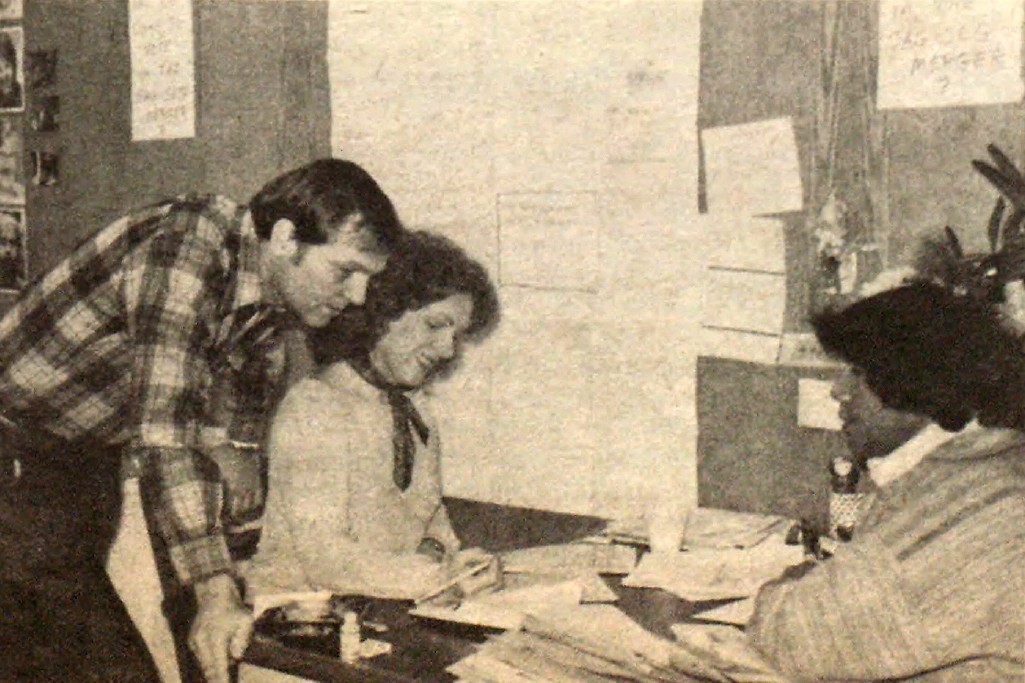
Eastern Principal Councilor Conard Fowkes (left) and Eastern Chorus Councilor Mary Lou Westerfield help a member in the VITA office in 1984.
"It was a neat place to go, but it was difficult to find anything for actors," she said. When she asked for help at the information desk, they informed her that Equity had a program just for people like her. She walked up Broadway to the VITA office and introduced herself to Enserro. He offered her some Florentine cake and they started to chat. Excited by her interest in the finer details of taxes, he encouraged her to volunteer with the program.
"You could not say no to that man," she said. "He was the nicest, sweetest, gentlest persuader I've ever met. And the rest is history for me."
History meant that for Karas, VITA opened two pipelines: one was to more courses and licensures, and she eventually became a tax attorney; the other was to greater volunteerism with the union and ultimately becoming an officer.
Karas's involvement in VITA also opened her eyes to ways the tax code unfairly penalized artists. For example, earnings on Equity contracts are reported to the IRS on the W2 form, and since that is typically associated with full-time employment, it precludes deductions for work expenses. However, most theatre artists have to incur a lot of costs to even get a job, from headshots to representation. In 1984, Karas approached Equity Executive Director Alan Eisenberg with a memorandum about the problem, setting into motion the advocacy that would create the Qualified Performing Artists deduction, passed in 1986. (Unfortunately, it was not indexed for inflation, and for years Equity and other performing arts unions and employers have been advocating for its update via the Performing Artists Tax Parity Act.) In the meantime, Karas kept returning to VITA, year after year.
In its earliest days, calling VITA headquarters an office was generous; it was a large janitor's closet across from the Council Room. Eventually, a real office in the building opened up, but it was unfurnished. VITA volunteers took the doors off the hinges and laid them across radiator covers as a makeshift desk.
Other improvements came over the years: real furniture, of course, and donated calculators from Canon that let users print while they typed. Eventually came computers and tax software, leading to greater speed and accuracy in returns (although Equity VITA volunteers have always prided themselves on their accuracy).
While many Equity members have tales of frustrating tax filing experiences, Gordon Stanley's bordered on a horror story.
"For a few years after I moved to New York in 1977, I went to an accountant that had been recommended to me and he was OK," he said. Then one day, Stanley opened the New York Times and was surprised to see his accountant in it.
"He had been indicted for stealing money from his soap star clients," he said. "Here I was signing a legal document I didn't understand that had been prepared by a criminal. What could possibly go wrong?
"Pretty shortly thereafter I got a notice from the IRS pointing out he had made several mistakes in one of my tax returns."
That brought Stanley to VITA, where Fowkes did his return, eventually drafting him to volunteer. For the last couple of years, Stanley has served as site coordinator, making sure that shifts are covered and that the program is in compliance with the IRS. And that requires a tight ship; while virtual signups for appointments ended the lines of five hundred people outside Equity offices at 6 a.m. on the first day of VITA season, and free or cheap tax software has allowed for more members to file on their own, VITA continues to file thousands of returns a year. Demand is plentiful, but supply of volunteers is always a push.
Volunteering Now
Equity member Kyle Cameron didn't need the push, nor had he used VITA's services before volunteering. As a Canadian, he had only been filing taxes in the States for a few years when he heard VITA was looking for fresh faces, but he is a big believer in volunteering and was looking for a new way to donate his time.
"I just thought, I'm good with numbers and details," he said. "I don't know very much about money, but I'm good at those fundamental components."
Now, Cameron has three tax seasons under his belt, and says he climbed that initial learning curve by the end of the first one. And every shift (he puts in 4 or 5 hours a week) is a learning experience.
"What's so incredible about the organization is that because we're all volunteers, there's an extensive pool of knowledge in that room – it's ok to ask for help," he said. "I am one of the youngest and least experienced preparers, but I feel very safe in that room that I can be accurate and supportive to the member because I feel so supported by the team of volunteers."
Over the years, other Equity or SAG-AFTRA programs have come and gone, including in Los Angeles, Seattle and Orlando. Finding enough volunteers to manage the office and especially to prepare taxes was usually what closed them. Longtime VITA volunteers urge other members to follow in their footsteps. (You don't even need to be good at math, they insist.)
"That's the most important thing to me," said Karas. "We are members volunteering to help other members," noting that after nearly fifty years, she is still fighting the misapprehension that anyone at VITA is paid for their time.
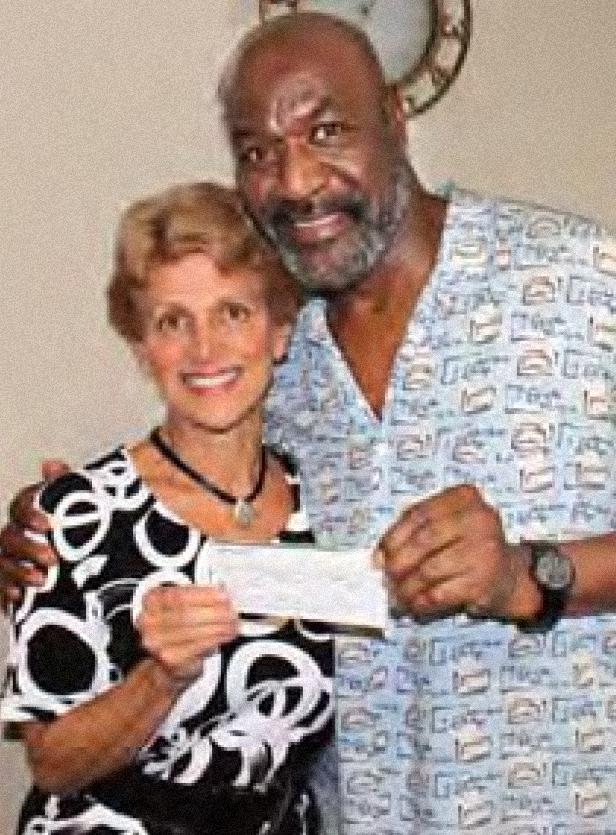
Equity Secretary-Treasurer and VITA Tax Director Sandra Karas (left) with Equity member Delroy Lindo in 2012, when he donated $10,000 to VITA in "give back" to the program that had helped him as a young actor.
And while VITA is still going strong, the makeup of the volunteers in the New York office has changed over the last decade or so. It is easier to find people to operate the phone – you do have to pass a test, albeit a short one. But now, it is more likely for tax preparers to come from outside the theatre industry, such as tax attorneys who come by for a year or two to do pro bono work. And many of the Equity volunteers have been at it for decades, which means they tend to be older. It's a tight-knit crew that shares tax tips and lifelong friendships.
"It's not a huge time commitment, there are good snacks, there's a surprising amount of laughs in the room, nice folks and a lovely way to take care of your fellow entertainment community folks who need assistance with a difficult task," said Cameron. "And there's tons of support all along the way."
Current VITA volunteers cannot promise, of course, that volunteering will be good for an Equity member's career, but Enserro coined the term the "VITA blessing" – in several cases, no sooner would actors or stage managers make a commitment to VITA than they would get a job offer that would pull them away. (It has already happened this year.)
For the self-described nerds at VITA, better understanding the tax system and the finances of theatre workers is its own reward.
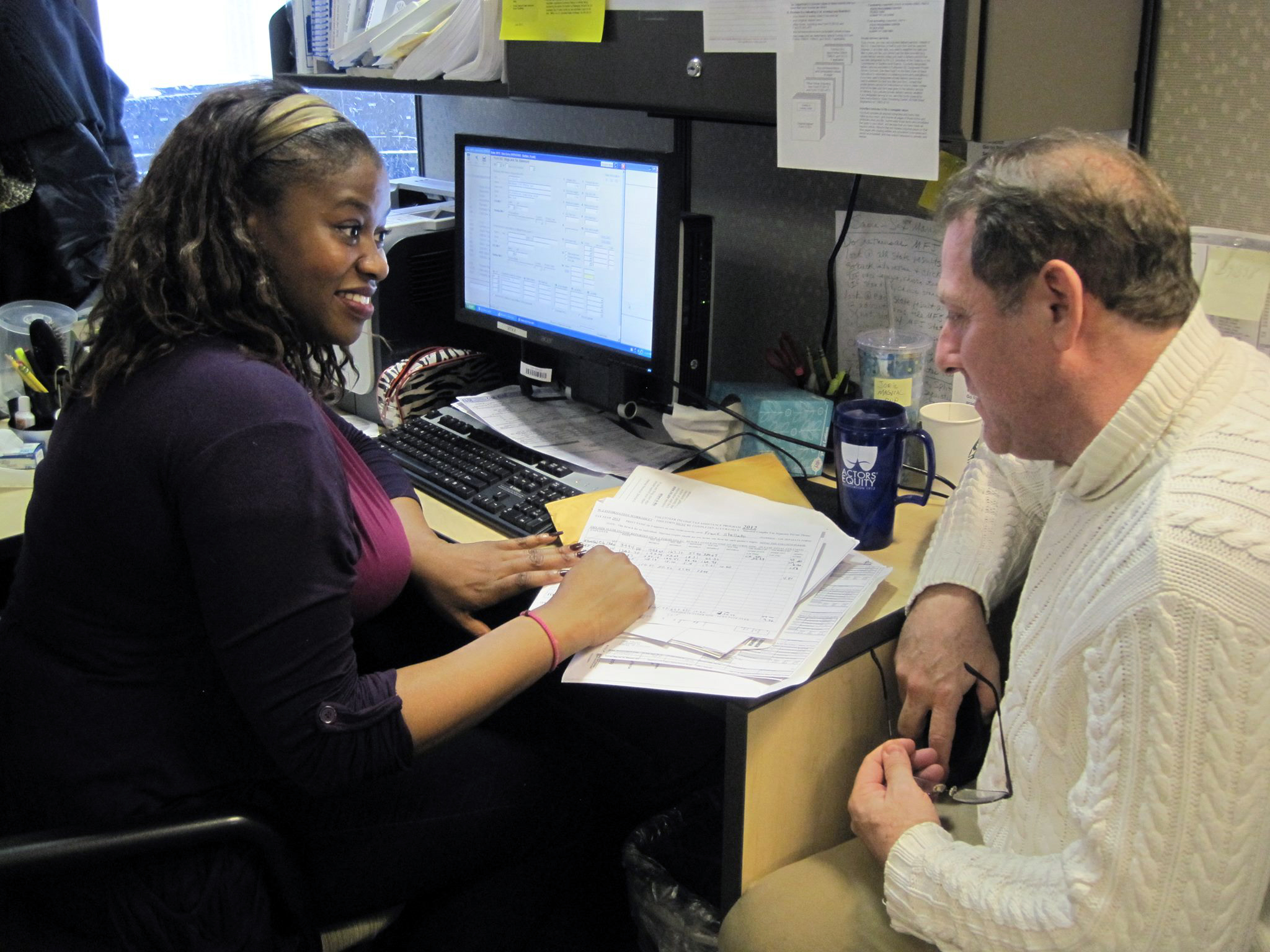
Equity member Nneoma Nkuku helps prepare taxes for fellow member Frank Stellato on VITA's opening day, 2014.
"Look – taxes are either the first or second biggest expense you will ever have in your life," said Stanley. "They're a huge expense, and most people simply don't understand that or understand the impact on their lives. When you get to do this, you see that very up close and personal... Also it's a fascinating way to see how people actually survive in this industry, the kind of survival jobs and how much they pay them and how they get along."
Most of all, VITA volunteers spoke about how satisfying it is to help a member in real time.
"Taxes are so stressful, and it can be really emotionally charged for some people," said Cameron. "People feel really overwhelmed by the task, and so the payoff in gratitude can be really high because people are like, 'Oh my God, thank you so much for doing this for me.'"
Whichever side of the VITA desk you might sit, volunteers want to see members in the office, feel the sense of camaraderie of performing artists helping other artists.
"If you are feeling put off by not having the knowledge of how to do this but you're curious, just come," said Cameron. "There is such a wealth of knowledge in that room and what appears to be a really complicated process is actually simpler than you think it is." The technology, tax code and faces have largely changed, but the sense of pride and the mission have not. And the coffee is still hot.